Some concerts are assignments. Some are nights out. And every once in a while, one comes along that manages to reach all the way back to the kid you used to be.
Dokken at the Rose Music Center was one of those nights.
It was another hot and steamy September day in Ohio, with temperatures flirting with triple digits and enough humidity to make you question why anyone voluntarily leaves air conditioning. I started packing my camera gear early because the Rose Music Center was a little over an hour from home, and there was another complication: I had been approved to shoot from the pit, but management reserved the right to move photographers to front of house.
In photographer language, that meant one thing.
Bring everything.
So I did.
As if the heat wasn’t enough, rain moved in during the drive, adding another layer of humidity to an already sticky evening. By the time I arrived in Huber Heights, the weather had apparently decided we should experience every possible form of moisture at once.
Opened in 2015, the Stuart & Mimi Rose Music Center at The Heights is a 4,200-seat, fully covered amphitheater just north of Dayton. Despite having covered countless shows over the years, this was my first time shooting there, so I arrived early, picked up my credentials, and was happy to see a familiar name on the media list: my good friend and previous guest of the show, photographer Tom Rentz.
Tom and I grabbed our gear, received our marching orders and headed toward the VIP area, where we had a chance to grab some food, talk shop, and work out a game plan for the evening. Since Tom had experience with the venue, I was more than happy to take advantage of the free scouting report.
It wasn’t long before the house lights dropped.
Time to work.
Lynch Mob Sets the Bar
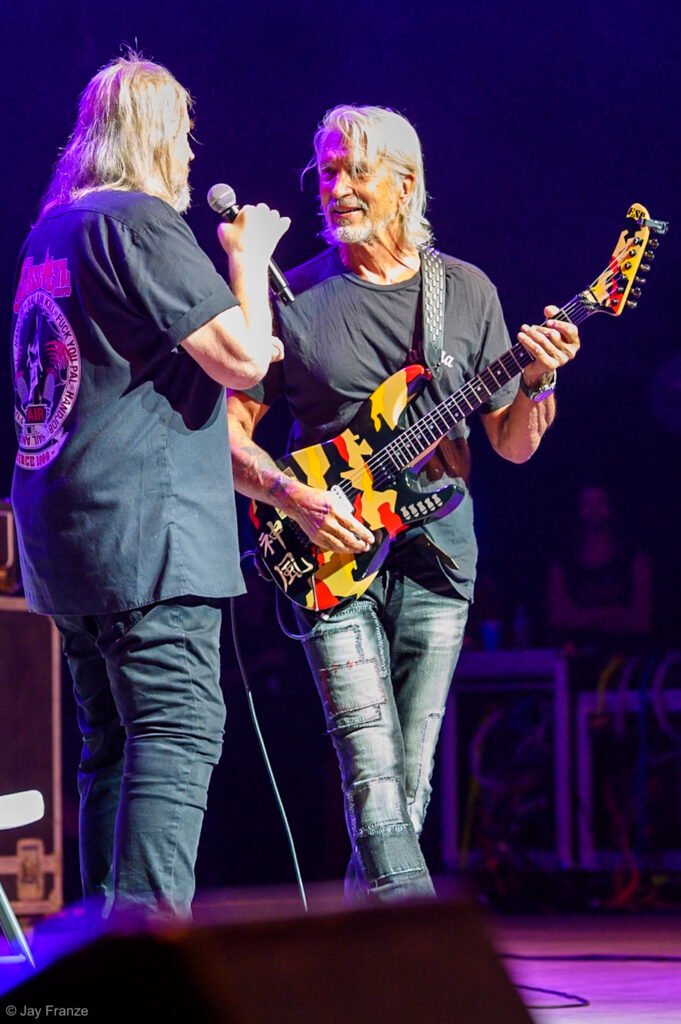
Opening the evening was Lynch Mob, led by legendary guitarist George Lynch.
For anyone familiar with Dokken’s history, Lynch’s presence made this more than your average opening slot. He was a key piece of Dokken’s classic lineup alongside Don Dokken, Mick Brown, and Jeff Pilson, helping create the guitar-driven sound behind some of the band’s most memorable records.
But this wasn’t a history lesson.
Lynch Mob came to play.
From the moment George Lynch stepped onto the stage, there was no question why his name continues to carry so much weight among rock guitarists. His playing was aggressive when it needed to be, melodic when it mattered and effortlessly cool throughout. There are players who seem to fight their instrument all night, and then there are guys like Lynch who make it look like the guitar simply knows what he wants before he asks.
The entire band delivered, and as an opening act, Lynch Mob created a slight problem for everyone following them.
They set the bar pretty damn high.
The Queen of Metal Celebrates 68
Next came Lita Ford.
Calling Ford a rock veteran almost feels inadequate. Her career stretches back to The Runaways before she established herself as a solo artist and became one of the defining women of hard rock and heavy metal. Her catalog includes the massive “Close My Eyes Forever,” recorded with Ozzy Osbourne, but her influence reaches well beyond any single song.
This particular performance came with another reason to celebrate.
It was Lita Ford’s 68th birthday.
The milestone was acknowledged from the stage, turning an already memorable stop into something a little more personal. Ford looked completely at home under the lights, delivering the kind of performance that comes from decades of knowing exactly who you are as an artist.
There was no attempt to pretend it was 1988 again.
There didn’t need to be.
This was Lita Ford in 2026, still holding a guitar, still commanding a stage, and still showing why generations of musicians who followed her owe her a debt of gratitude.
And then it was time for the band I had been waiting for.
In My Dreams
Dokken has always been one of my favorite bands.
Growing up with this music, songs like “In My Dreams,” “Alone Again,” “Breaking the Chains,” and “Burning Like a Flame” weren’t simply tracks from another rock band. They were part of the soundtrack.
Formed in Los Angeles in the late 1970s, Dokken became one of the bands that helped define melodic hard rock during the 1980s. They sold millions of albums, landed songs on the charts and earned a Grammy nomination for Beast from the East. But statistics only explain part of Dokken’s longevity.
The songs explain the rest.
When Don Dokken and the band finally took the stage at Rose Music Center, decades of memories came with them.
It was also impossible not to notice the physical challenges Don Dokken now faces following complications from spinal and neck surgery in 2019. Those challenges have clearly changed the way he moves onstage.
But they didn’t keep him off it.
A chair had been placed onstage for him if he needed it.
He never used it.
Instead, Dokken remained on his feet throughout the full set, working through a catalog that has followed both the band and its fans for decades. There was something meaningful about watching him continue to perform despite the obvious physical limitations. This wasn’t about pretending time hadn’t passed. Quite the opposite.
The years were right there onstage.
So were the songs.
And sometimes that makes the music mean a little more.
The band worked through the hits, and for me, there was something surreal about standing in the pit with a camera in my hands photographing a band I had listened to growing up. I’ve been fortunate enough to spend a large portion of my life around music. I’ve worked in studios, stood backstage, mixed shows, and photographed more concerts than I can count.
Yet every now and then, the fan still manages to sneak past the professional.
This was one of those nights.
Then came the encore.
And everything changed.
Closing the Loop
George Lynch walked back onto the stage.
Suddenly, the guy we had photographed opening the evening was standing alongside Dokken again.
Even better, photographers were allowed back into the pit to shoot it.
There are moments when you’re very aware of the camera settings, the lighting, the shutter speed and whether you’ve got the shot.
Then there are moments when you have to remind yourself to actually press the shutter because you’re too busy appreciating what’s happening in front of you.
Seeing George Lynch perform with Dokken provided the perfect ending to the night. For longtime fans, the history between Lynch and Don Dokken is well documented, which only made seeing them share a stage again feel more significant.
For me, it closed a loop.
I had watched Lynch Mob open the evening. I had photographed George Lynch doing what George Lynch does. Then, hours later, I was standing a few feet from the stage photographing him playing with Dokken.
The band I grew up listening to.
With the guitarist I associated with those records.
Through the lens of my camera.
Not bad for a Saturday night in Ohio.
When the final notes faded, it was time to pack everything back into the camera bag, say goodbye to Tom and make the long drive home.
Naturally, the rain joined me again.
By the time I finally made it through the front door, common sense suggested that I should put the gear down and go to bed.
Common sense has apparently never photographed a concert.
I sat down at the computer and started going through the night’s images.
One became ten. Ten became a hundred. Before I knew it, it was 4:00 in the morning.
I wasn’t tired.
I was still back at the Rose Music Center.
That’s the thing about nights like this. You can document them with thousands of photographs, but the best part isn’t necessarily what’s stored on the memory cards.
It’s realizing that somewhere between the heat, the rain, the camera gear, Lita Ford celebrating a birthday, George Lynch tearing into a guitar, and Don Dokken refusing to sit down, you got to spend a few hours with the music that helped shape you.
More than four decades after Dokken began its journey, the lineup may have changed, the world certainly has, and none of us are the same people we were when these songs first came blasting through our speakers.
But when the lights go down and that first familiar riff hits?
For a little while, none of that matters.
Every show has a story.
Sometimes, if you’re lucky, part of that story is your own.
Links
- Artist: https://dokken.net/
- Artist: https://www.litafordonline.com/
- Artist: https://georgelynch.com/
- Photos: https://jayfranze.com/dokken-rose-music-center-huber-heights-oh-9-19-26-photos/
- Photos: https://jayfranze.com/lita-ford-rose-music-center-huber-heights-oh-9-19-26-photos/
- Photos: https://jayfranze.com/lynch-mob-rose-music-center-huber-heights-oh-9-19-26-photos/